


World Cup Grass Has a Robot Foot. Your Local Soccer Field Has a Group Text.
At the 2026 World Cup, the grass is being treated like a Formula 1 chassis.
Across 16 stadiums in North America, agronomists, sod farmers, and turf scientists have spent years engineering living surfaces for wildly different climates. Cooler venues like Toronto and Philadelphia run a Kentucky bluegrass and perennial ryegrass mix. Hotter cities like Miami, Guadalajara, and Monterrey use bermudagrass. Most pitches grow over synthetic underlayers. The tolerances are tight enough that a short stretch of turf may allow only a few millimeters of height variation.
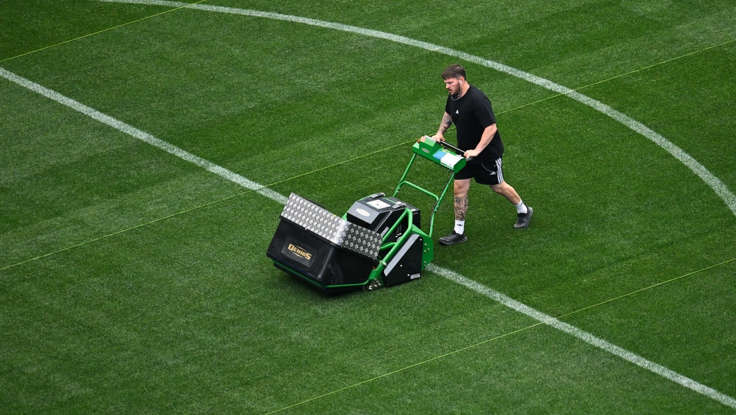
To validate the surfaces, FIFA's researchers used a patent-pending machine called the fLEX, a mechanical foot that stamps and twists into the grass the way a player does when they plant and cut. It simulates athletes from 35 to 350 pounds and measures the forces the surface sends back. The team ran it across roughly 125 candidate fields. This is sports infrastructure, not landscaping.
Now drive twenty minutes out to the fields where hundreds of kids actually play every weekend. The operating system there is a clipboard in the maintenance shed, a spreadsheet nobody updates, and a group text that detonates after every hard rain:
Are the fields open?
Coach says Field 3 looks fine.
Who checked the goals?
Can the U12 games move to Field 5?
Did anyone tell the tournament director?
That gap is the opportunity. Not a miniature World Cup turf lab, not an agronomy platform, not a six-figure municipal maintenance suite. Build the thin operating layer that tells a youth sports complex whether each field is open, limited, or resting, and keeps the evidence behind every call. Call it FieldReady.
The money: At $1,000 to $1,800 per facility a year, 100 complexes is a solid six-figure SaaS. A focused founder can reach $10K to $30K MRR solo.
Inside:
• 7-feature MVP scope, soccer-first
• Per-facility pricing tiers, free to $299
• 90-day plan: pilot to case study
• Two compounding moats: memory, benchmarks
The asset nobody put in the software stack
Youth sports stopped being a weekend hobby economy a long time ago.
L.E.K. Consulting cites a U.S. youth sports market of roughly $40 billion a year, with about 30 million kids moving through tens of millions of organized events. Capital has noticed. More than $2.5 billion went into new or upgraded youth sports complexes between 2024 and 2026, and the operators building them, like The Sports Facilities Companies and KemperSports, are bolting on digital scheduling and registration to squeeze more revenue out of every field-hour.
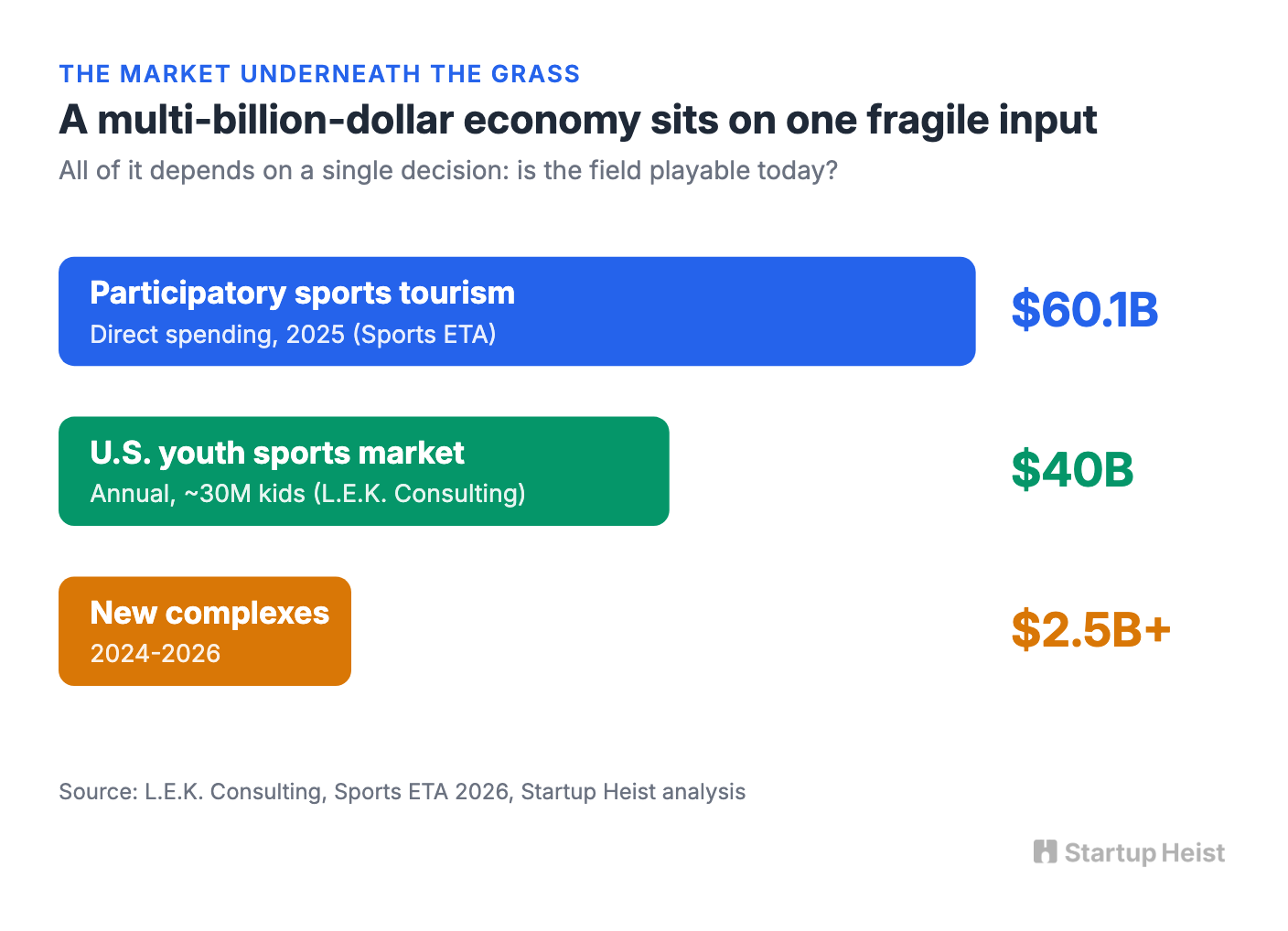
The economics of a tournament weekend make uptime non-negotiable. Sports ETA's 2026 report put participatory sports tourism, driven mostly by youth and amateur events, at $60.1 billion in direct spending in 2025. That money moves through hotel blocks, restaurants, registration fees, and local businesses. All of it sits on top of one fragile input: a playable surface. A rained-out field isn't a maintenance footnote. It can blow up a weekend involving dozens of teams and hundreds of traveling families who already booked rooms.
Yet the field itself lives outside the software the complex already pays for. There's a product for registration, another for scheduling, another for payments, maybe a generic work-order tool for repairs. The one decision that gates all of it stays stubbornly analog:
Is this field safe and playable today?
That question is heavier than it sounds. A field can look fine from the parking lot and still hide standing water, bare hard-soil patches, ruts, exposed sprinkler heads, an unanchored goal, or a chewed-up goalmouth. The Sports Field Management Association publishes a pre-game soccer checklist covering exactly this: turf coverage, drainage, holes, goal anchoring, fencing, markings, and the handoff between grounds staff and the coach about to send kids onto the grass. The discipline already exists at the high end. The National Park Service treats turf as a monitored facility asset, and parks and recreation departments routinely close fields after heavy rain or frost.
The youth version of that discipline doesn't need a thick manual. It needs a five-minute walkaround on a phone.
The product: a readiness log, not another maintenance platform
FieldReady should feel like a pre-flight checklist, not a facility-management console.
A groundskeeper, ops manager, or trusted coach walks the field and scans a QR code staked near the entrance. The app opens straight to that field. No menus, no desktop login. They answer a short, blunt list:
- Standing water anywhere?
- Bare spots, holes, ruts, or trenches?
- Goalmouth badly worn?
- Goals anchored?
- Exposed sprinkler heads, grates, or other protrusions?
- Markings visible?
- Hazards in the run-off area?
- Open, limited, or resting?
They snap two or three photos, tap a status, and submit. The public field board updates instantly:
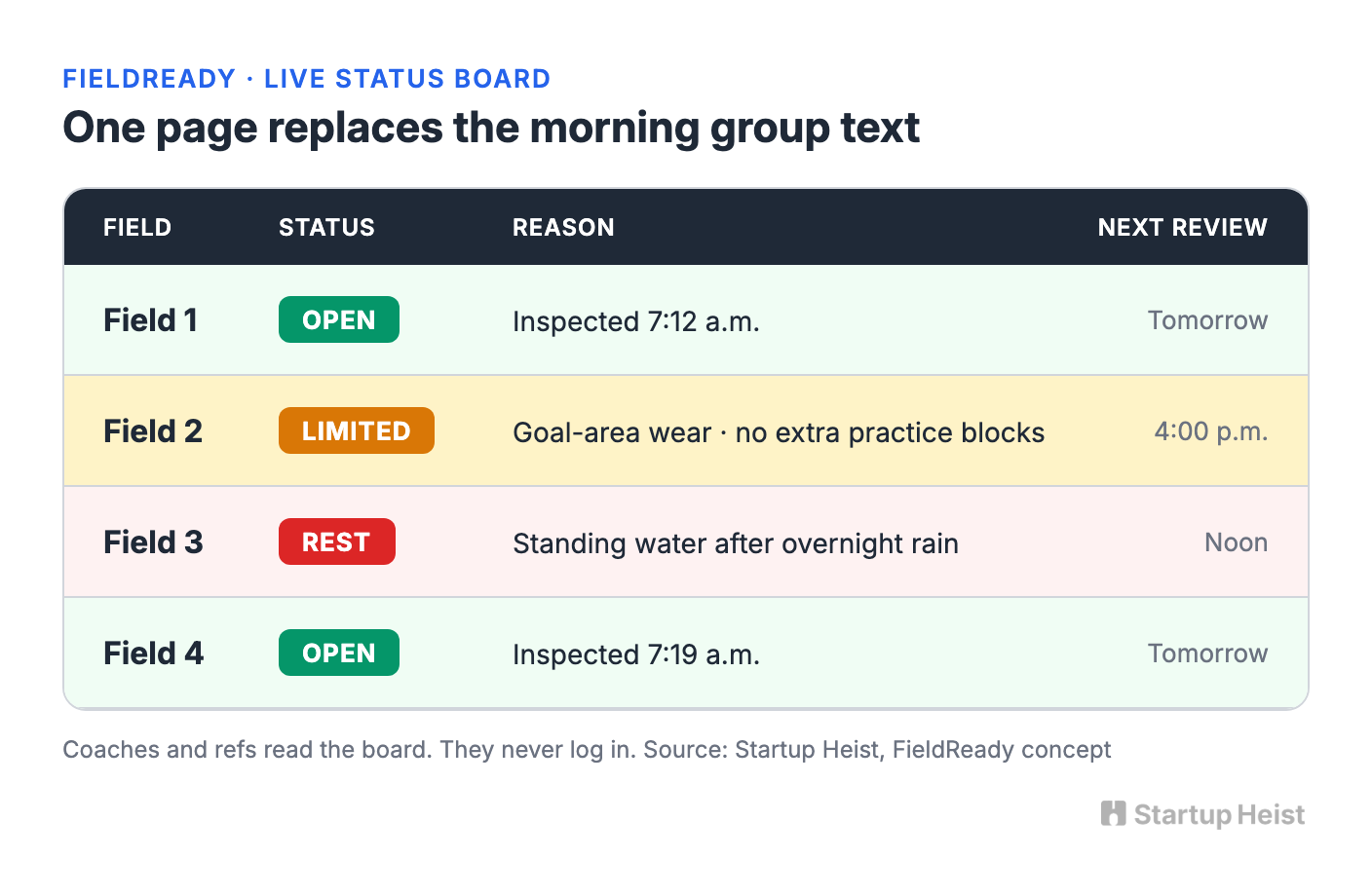
Coaches, refs, and tournament directors get the board without ever touching internal maintenance workflows. That separation is the whole trick. Most of these people don't need work orders, inventory, or labor tracking. They need an authoritative answer that is easy to read and hard to argue with. FieldReady turns a subjective hallway debate into a documented operating decision.
The wedge: soccer complexes, not city hall
The broad market is everything with grass: public parks, school districts, small colleges, camps, private clubs, multi-sport campuses.
Don't start there.
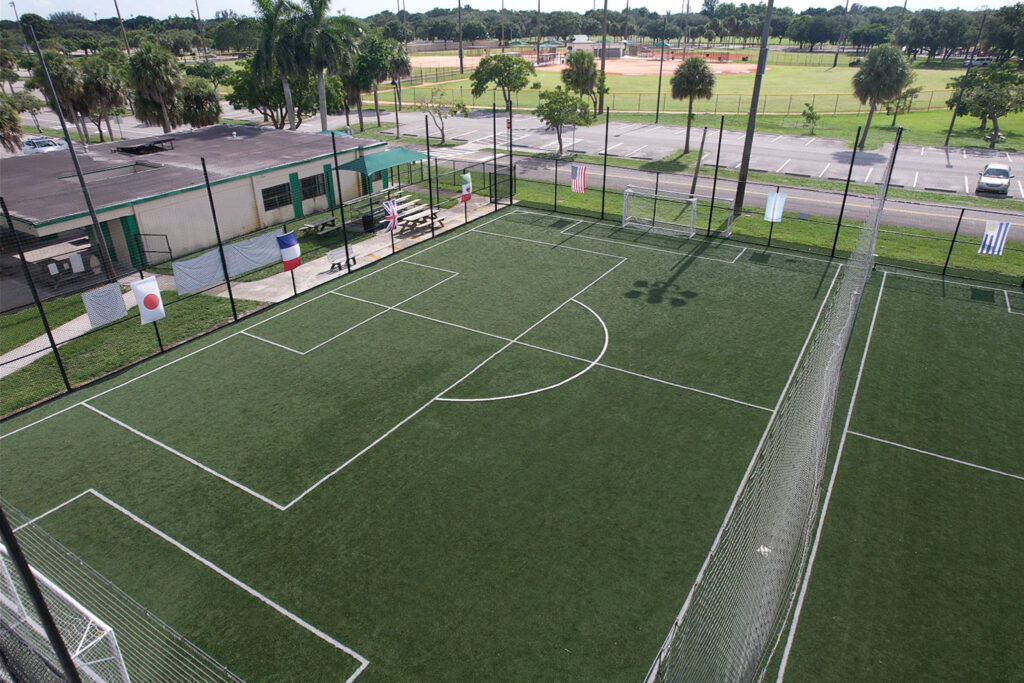
The first customer is a privately operated, soccer-heavy complex with four to twelve outdoor fields. Soccer is the right entry point because the wear is concentrated and visible. World Cup turf coverage notes that the area in front of the goal takes a relentless beating, and a tournament complex lives that pattern at small scale: goalmouths degrade fast, rain forces same-morning calls, weekend tournaments compress a week of play into 48 hours, and one botched closure can torch an operator's reputation with a dozen clubs at once.
The owner-operator can say yes after a 30-minute demo because the product fixes something that bit them last Saturday. A parks department can't. It has a procurement cycle. Private complexes are the short-cycle beachhead; parks and districts become the expansion market once the product has evidence, templates, and a clean integration story.
The competition isn't the enemy. It's the proof.
This market isn't empty, and that's good news. It means buyers already believe operations software is worth paying for.
The incumbents cluster at two ends. On the heavy side, Productive Parks sells a full maintenance-management platform for parks agencies, with work orders, labor tracking, asset management, and inventory, starting around $200 a month with five users included; FMX and SportsKey play in the same broad zone of assets, rentals, scheduling, and event management. On the light side, generic inspection apps like GoAudits already market mobile sports-field inspections with checklists, photos, corrective actions, offline mode, and audit trails, starting near $12 per user per month.
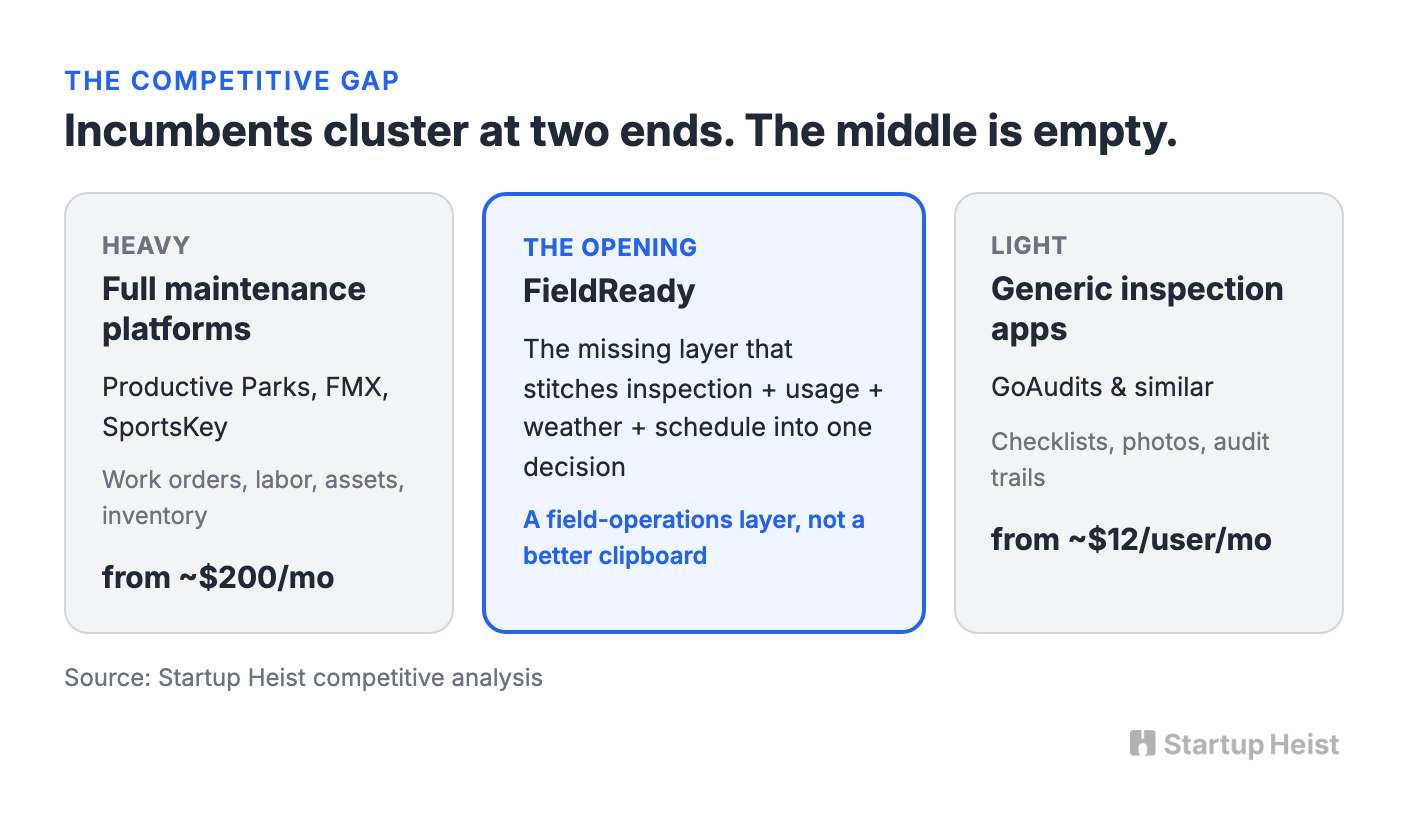
That light end matters most. It proves a digital checklist alone isn't a company. You could rebuild a paper form inside a generic inspection app this afternoon. That isn't the heist. The opening is the missing layer that stitches together inspection, field usage, maintenance history, weather, and the schedule-facing decision. Generic tools document a problem. FieldReady should answer the operator's real questions: which fields are carrying too many play hours, which goalmouths keep failing after tournaments, which surface should rest before the next storm, and which booking blocks need to move the moment Field 3 flips to limited.
That isn't a better clipboard. It's a lightweight field-operations layer, and it's where the rest of this playbook goes.
What the MVP actually includes
Resist the urge to build a parks platform. Version one needs seven things.

Unlock the Vault.
Join founders who spot opportunities ahead of the crowd. Actionable insights. Zero fluff.
“Intelligent, bold, minus the pretense.”
“Like discovering the cheat codes of the startup world.”
“SH is off-Broadway for founders — weird, sharp, and ahead of the curve.”


